Kurs aus TUMOnline ( S2025)
- Dozent: Cara Hähl-Pfeifer
- Dozent: Andres Lepik
- Dozent: Sarolta Ilona Szatmári
Kursbereich: ED Architecture
Lernplattform Moodle
Technische Universität München

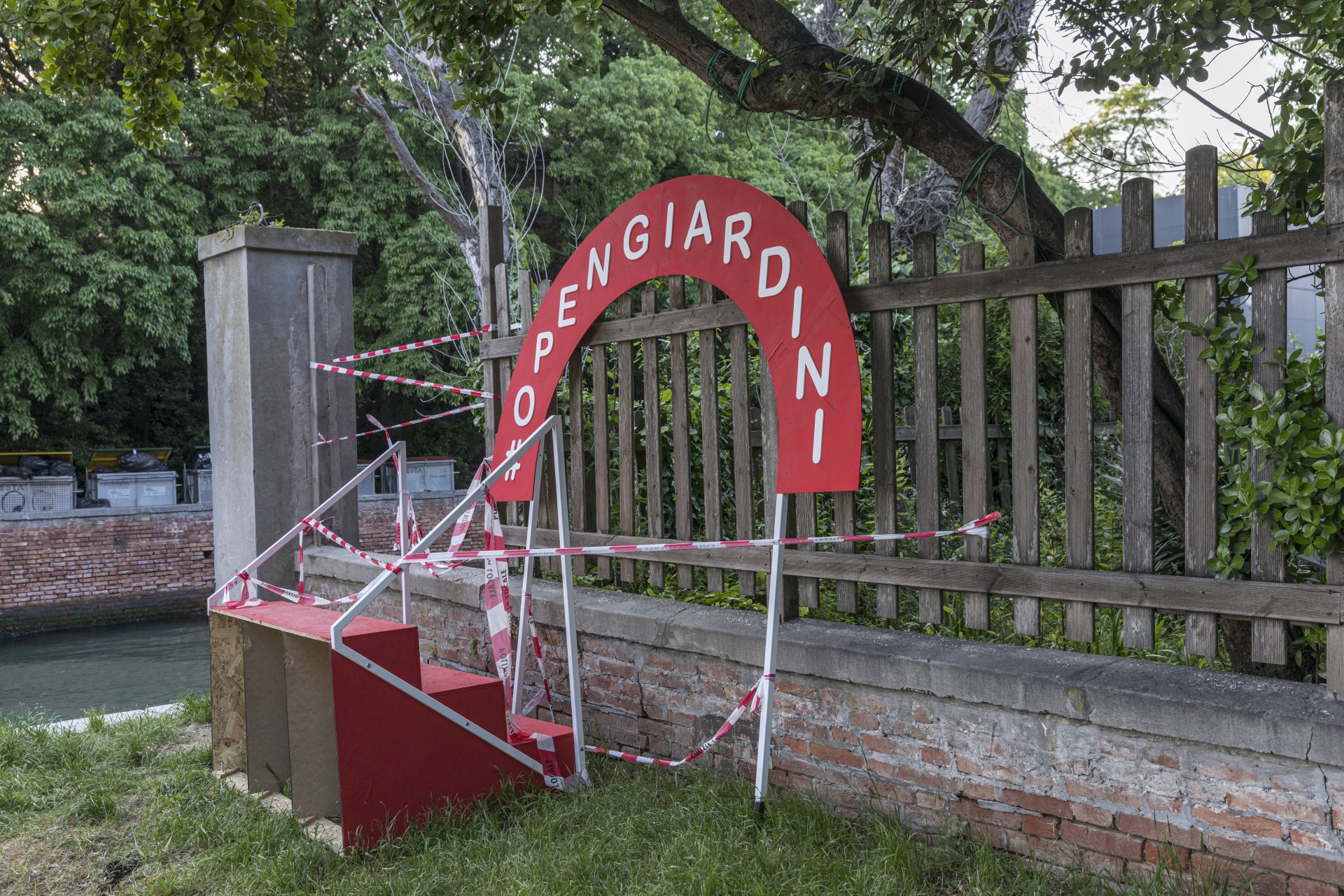
What makes an architecture exhibition engaging for visitors? What makes an exhibition participatory? How can visitors deepen their understanding and reflect on the exhibition’s topics?
This seminar is the continuation of the Bachelor thesis EXHIBIT EXCHANGES: The Pedagogical Potential of Inquiry-Based Social Visits at Architecture Exhibitions. It lies at the intersection of multiple fields: critical architecture curation and education, museology, and pedagogy.
In this seminar, we will explore different methods of engaging exhibition audiences through lectures, including insights from The Participatory Museum by Nina Simon, as well as through excursions to various museum events in Munich. These activities will prepare us to engage with the new exhibition Visual Investigations at the Architekturmuseum der TUM, where we will conduct a brief critical analysis of the exhibition with a focus on visitor experience and engagement, drawing on the knowledge gained throughout the semester.
The seminar will conclude with a team-based proposal of experimental strategies to enhance visitor engagement and learning at the exhibition. A fun final session of hands-on experimentation within the exhibition will allow us to test these proposed strategies.
We look forward to learning and reflecting with you!

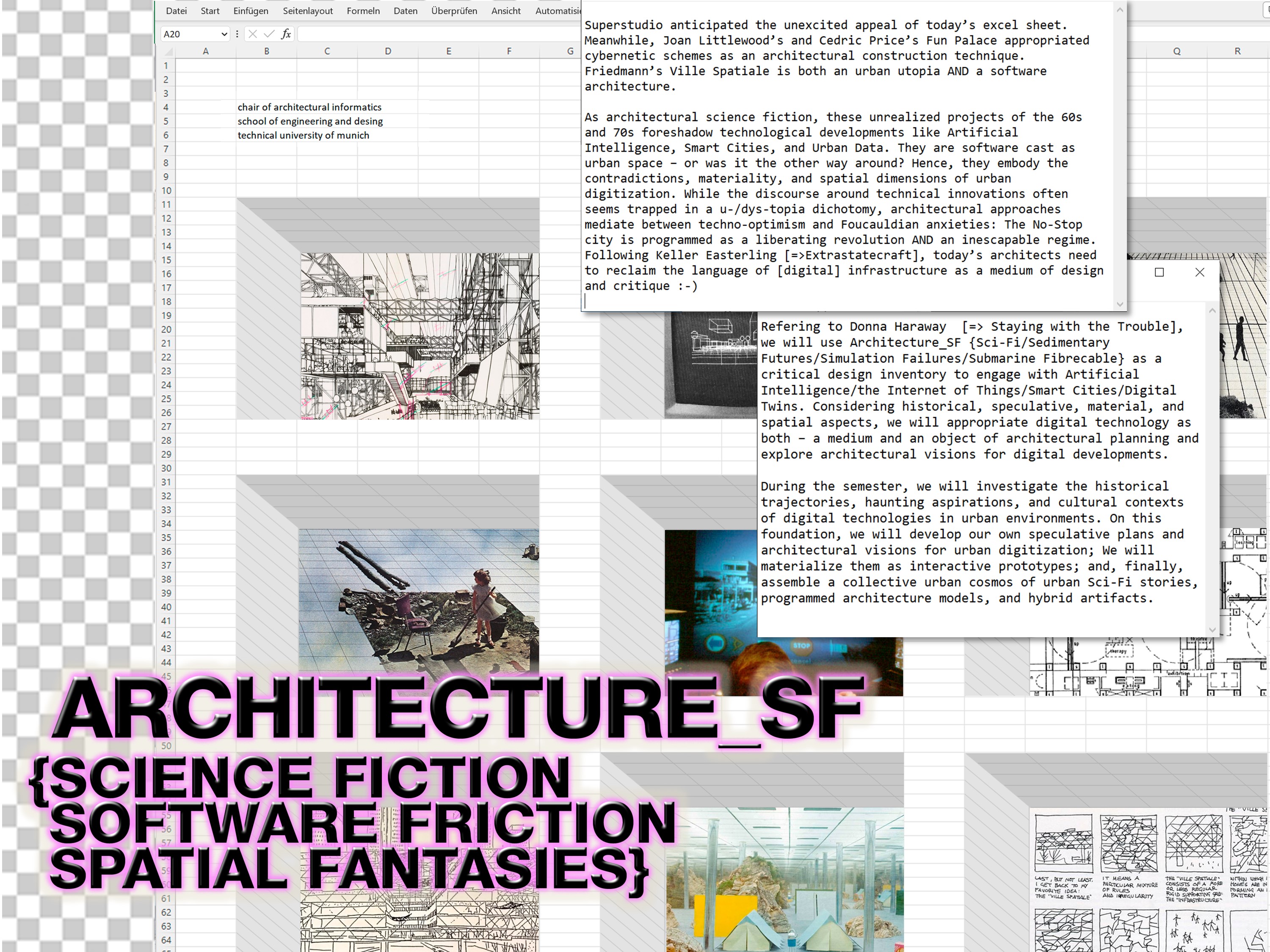
Wir leben in einer Welt rasanter Kommunikation: Werbung hat zwischen 15 und 30 Sekunden Zeit, um uns zu überzeugen. Als Twitter gegründet wurde, war seine Besonderheit die Begrenzung einer Nachricht auf maximal140 Zeichnen, um sich auszudrücken. Japanische Haikus, Meisterwerke der Literatur, haben nur drei Zeilen, in denen sich die Schönheit der ganzen Welt widerspiegelt. Schaffen wir es, in maximal zwei Minuten lebendig, frisch, fantasievoll und plakativ die Faszination für unser Studium zu vermitteln?
Bilder und Stimmen, Farben und Töne sind die Zutaten einer Videobotschaft, aber das reicht nicht. Erstmal braucht man Ideen, um die Leute neugierig zu machen. Teaser müssen viral gehen!
Die Message: "Deshalb studiere ich Landschaftsarchitektur an der TUM!"
-
Focus of the Short Design module is the independent processing of predetermined design issues in a short period of time. Experimental design under precisely defined conditions should train the development of ideas and the ability to take and communicate design decisions. The output includes working models, sketches and texts documents.
We live in a world of fast-paced communication: advertising has between 15 and 30 seconds to convince us. When Twitter was founded, its peculiarity was the limitation of a message to a maximum of 140 characters to express ourselves. Japanese haikus - masterpieces of literature - have only three lines in order to reflect the beauty of the whole world. Can we manage to convey the fascination of our studies in just two minutes in a lively, fresh, imaginative and striking way?
Images and voices, colors and sounds are the ingredients of a video message - that's anyway not enough. First of all, you need ideas to make people curious. Teasers have to go viral!
The message: "That's why I'm studying Landscape Architecture at TUM!"
Wir leben in einer Welt rasanter Kommunikation: Werbung hat zwischen 15 und 30 Sekunden Zeit, um uns zu überzeugen. Als Twitter gegründet wurde, war seine Besonderheit die Begrenzung einer Nachricht auf maximal140 Zeichnen, um sich auszudrücken. Japanische Haikus, Meisterwerke der Literatur, haben nur drei Zeilen, in denen sich die Schönheit der ganzen Welt widerspiegelt. Schaffen wir es, in maximal zwei Minuten lebendig, frisch, fantasievoll und plakativ die Faszination für unser Studium zu vermitteln?
Bilder und Stimmen, Farben und Töne sind die Zutaten einer Videobotschaft, aber das reicht nicht. Erstmal braucht man Ideen, um die Leute neugierig zu machen. Teaser müssen viral gehen!
Die Message: "Deshalb studiere ich Landschaftsarchitektur an der TUM!"
-
Focus of the Short Design module is the independent processing of predetermined design issues in a short period of time. Experimental design under precisely defined conditions should train the development of ideas and the ability to take and communicate design decisions. The output includes working models, sketches and texts documents.
We live in a world of fast-paced communication: advertising has between 15 and 30 seconds to convince us. When Twitter was founded, its peculiarity was the limitation of a message to a maximum of 140 characters to express ourselves. Japanese haikus - masterpieces of literature - have only three lines in order to reflect the beauty of the whole world. Can we manage to convey the fascination of our studies in just two minutes in a lively, fresh, imaginative and striking way?
Images and voices, colors and sounds are the ingredients of a video message - that's anyway not enough. First of all, you need ideas to make people curious. Teasers have to go viral!
The message: "That's why I'm studying Landscape Architecture at TUM!"

The iLab: Build your own Internet is a lab course offered by the Network Architectures and Services group at Technische Universität München.
In the iLab you learn to build networks equipped with all the important network protocols making up the Internet of today. When you finish the course, you will be able to build up a working Internet with all required technologies on your own!
The theoretical contents of the networking lectures are explored in practical exercises. You will set up all these services (and more) by yourself and learn how they work in detail:
We will see how machines can be provisioned with network configuration (e.g. SLAAC). With dynamic routing protocols, such as OSPF, networks are made resilient against failures. DNS and DNSSEC are set up to provide name resolution from the root zone downwards.
We will look at security protocols and see how TLS can be used securely in the popular combination with HTTP. To look into modern protocols, we will have a look into QUIC, the new basic technology for the Internet with enforced encryption. We break popular WLAN encryption and set up more secure protocols instead. For link layer authentication, we use 802.1X and RADIUS.
In a team of two, you have 6 Xeon GNU/Linux machines and 2 Cisco routers to set up the network topologies and work on the tasks. We offer a lecture as well as preparatory materials with quizzes.
The course is in English, which means you can practice your English skills. If you don't know it already, you will also become familiar with GNU/Linux, which is used extensively in the exercises.

The intended audience of this course is everyone who wants to understand how computer networks work.
Basic knowledge in computer networks is expected.
Knowledge of the GNU/Linux operating system is an advantage, but not required. You will get all required information during the course.
As you will use Linux throughout the whole practical exercise, getting along with this operating system will be another benefit for you in the course.
The course consists of ten exercises.
You will normally have one week for an exercise; for longer exercises, two weeks will be scheduled.
The practical exercises are performed in teams of two students.
You should try to find a team partner on a similar level regarding the networking background, as well as the Linux operating system.
An exercise consists of three parts:
The course is held entirely in English. You are expected to answer the questions in English as well. This is a good opportunity to exercise and improve your language skills!
In contrast to many other practical exercises the course is entirely based on a web system. You will have access to this web system from anywhere on the Internet.
This allows you to freely choose when to do the prelab or final adjustments to your answers.


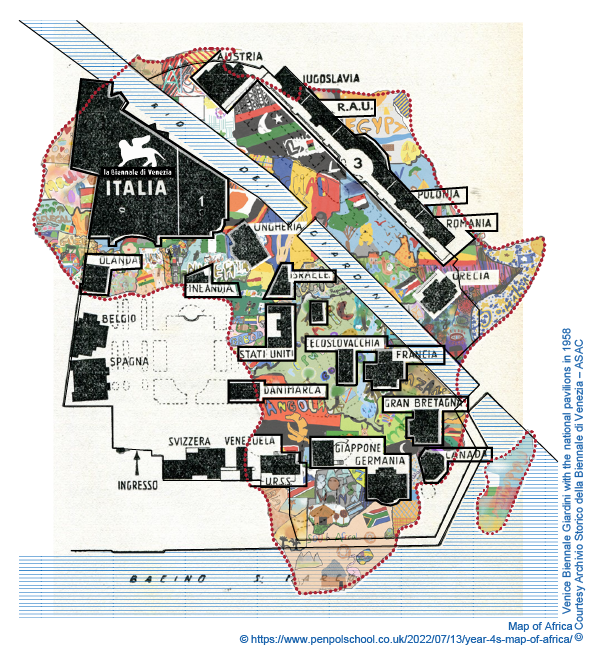

Description DE: Das Seminar untersucht Möglichkeiten des Erinnerns an das faschistische Erbe in München, indem bestehende und zerstörte Gebäude in ihrer geschichtlichen Bedeutung analysiert werden. Grundlegende Fragestellungen dabei sind: Was sind die unterschiedlichen Betrachtungsperspektiven auf den Nationalsozialismus, auf die Täter, die Opfer und Mitläufer, wie kann an die Protagonisten des Widerstands erinnert werden, welche Haltung hatte hierzu die Nachkriegsgeneration, welche haben wir heute? Welche Ereignisse und Taten bleiben in den erhaltenen Bauten und Relikten präsent und was ist nur noch in Dokumenten und mündlichen Überlieferungen zu finden? Wie kann man dem Vergessen entgegentreten, die Erinnerung aktivieren und den Aufstieg einer neo-nationalistischen Politik begegnen? Der aktive Umgang mit dem nationalsozalistischen Erbe in München wird in einer Reihe von Vorträgen, Gesprächen und Spaziergängen thematisiert, ein Schwerpunkt liegt auf künstlerischen Strategien. Die Studierenden werden aufgefordert, einen Vorschlag zu entwickeln, wie man an eine Fallstudie faschistischer Architektur erinnern kann. Die Exkursion und der Workshop mit der Freien Universität Bozen (Prof. Roberto Gigliotti / Dr. Elisabetta Rattalino) dienen dem Austausch und dem Kennenlernen, wie Italien sich an sein faschistisches Erbe erinnert.

In preparation for an upcoming exhibition at the Architekturmuseum der TUM, this seminar offers an in-depth exploration of architectural investigation and design activism. Through lectures and project analyses, participants will gain insights into the methodologies of Forensic Architecture, SITU, and other influential offices. The focus will be on how these practices employ spatial analysis, technology, and research to uncover truths, advocate for justice, and redefine architecture's role in society. Participants will contribute to the exhibition by incorporating their gathered insights and produced work and collectively reflect on how to communicate this content to a lay audience.

This course provides an in‑depth introduction to quantum computing with superconducting qubits, focusing on both theoretical foundations and practical implementations. Building on core concepts from quantum mechanics and quantum information, we explore superconducting circuit architectures and develop models using Lagrangian and Hamiltonian formalisms to understand resonances, couplings, and qubit dynamics. Various qubit modalities, including transmons, flux qubits, fluxonium, and related designs, are discussed.
A central theme of the course is the impact of noise and decoherence in real devices. We examine noise sources, mitigation strategies, calibration techniques, and chip characterization methods essential for operating superconducting quantum processors. Beyond theory, the course covers fabrication considerations, implementation of single‑ and two‑qubit gates, and applications in quantum algorithms and quantum simulation.
The course concludes with an overview of current challenges and use cases in the NISQ era, including hybrid classical‑quantum algorithms and the principles of quantum error correction required for fault‑tolerant quantum computing.
Level – Intermediate to Advanced: A conversation course
on current topics at TUM ranging from university structure, sustainable
architecture or artificial intelligence. We will read articles, watch
videos and discuss TUM related ideas determined by the participants.

This course provides an in‑depth introduction to quantum computing with superconducting qubits, focusing on both theoretical foundations and practical implementations. Building on core concepts from quantum mechanics and quantum information, we explore superconducting circuit architectures and develop models using Lagrangian and Hamiltonian formalisms to understand resonances, couplings, and qubit dynamics. Various qubit modalities, including transmons, flux qubits, fluxonium, and related designs, are discussed.
A central theme of the course is the impact of noise and decoherence in real devices. We examine noise sources, mitigation strategies, calibration techniques, and chip characterization methods essential for operating superconducting quantum processors. Beyond theory, the course covers fabrication considerations, implementation of single‑ and two‑qubit gates, and applications in quantum algorithms and quantum simulation.
The course concludes with an overview of current challenges and use cases in the NISQ era, including hybrid classical‑quantum algorithms and the principles of quantum error correction required for fault‑tolerant quantum computing.
Moodle-Support: moodle@tum.de, Tel. 089-289-24273